
Letter
Ottawa, September 26, 2024
The Honourable Anita Anand
Minister of Transport
Transport Canada
Place de Ville, Tower “C”
330 Sparks Street, 29th Floor
Ottawa, Ontario K1A 0N5
Dear Minister:
RE: Annual Report 2023-2024
I am pleased to present the annual report of the Transportation Appeal Tribunal of Canada for the fiscal year 2023-2024. This report was shared with your predecessor in June of 2024 pursuant to section 22 of the Transportation Appeal Tribunal of Canada Act.
It is an honour and privilege to serve Canadians in Canada’s national transportation sector.
Yours sincerely,
Gary Drouin
Chairperson
Message from the Chairperson

I am pleased to present the 2023-2024 Annual Report of the Transportation Appeal Tribunal of Canada (Tribunal). This report continues to express how important the Tribunal is in Canada’s transportation sector. Once again, the past year has truly highlighted the Tribunal’s enormous impact on the lives and livelihoods of so many Canadians. This includes federally-regulated institutions in the maritime, rail, aviation, automobile safety and international bridge and tunnel sectors.
The Tribunal showed resolve amid post-pandemic adaptations, thanks to the dedication of the staff who supported its mandate. My special appreciations go to the members who applied their unparalleled expertise to each of the transportation sectors supported by the Tribunal. As several members were awaiting reappointment, the rest shouldered an exceptional amount of review and appeal hearings. While addressing this temporary but difficult situation, they guaranteed access to justice for Canadian individuals, companies and institutions. Although the collective effort has surpassed all expectations, the situation needs to be rectified.
Indeed, difficulties encountered include recruiting and retaining members with the expertise required to conduct hearings in all the Tribunal’s areas of jurisdiction. This issue directly affects the Tribunal’s ability to fulfill its mandate. However, Minister Rodriguez presented Cabinet with his recommendation to reappoint more than ten members. This support will undoubtedly have a positive impact on the Tribunal’s operations once the Governor in Council approves the renewals.
The Tribunal has adopted a two-pronged approach to recruit members, examining best practices and innovative methods to:
- inform stakeholders to foster recruitment reflecting the diversity of Canadian society; and,
- inform the entire transportation community to ensure representation of the expertise, professional disciplines, and rich experience that define this community.
This year, the Tribunal succeeded again in implementing many reforms designed to reflect the new realities of Canadian society, and consequently to serve the needs of its clientele better. Thanks to these administrative changes and adaptations, the Tribunal has established the necessary infrastructure, adaptation capacity and professional expertise.
The Tribunal’s efforts in this regard include:
- a complete overhaul of the website in terms of structure and plain language;
- the integration, in all decisions and other publications, of simple, easy-to-understand, inclusive and accessible language, for Canadians and for foreign entities and individuals affected by the Tribunal’s jurisdiction;
- the ongoing revision of guides to support an easy and efficient experience with the Tribunal to serve the needs of the parties better;
- a change of virtual hearing platform to help members draft their decisions and to facilitate compliance with the Official Languages Act.
Communication with members remains a priority, to keep them abreast of innovations within the Tribunal and to help them improve their skills in the conduct of hearings. Two examples follow.
- The Tribunal has developed a new guide for in-person hearings, to ensure the safety of members and to provide participants with a healthy environment and adequate space.
- The Tribunal held a virtual strategic retreat with the members who preside over case management conferences (CMC). As a result, it simplified the documents related to CMCs and it decided not to hold them in the rail sector when the parties agree to proceed directly to the hearing. In so doing, the Tribunal has adapted to its clientele and gained in efficiency.
As far as communications go, it is also important to extend the Tribunal’s information and awareness program to all its areas of jurisdiction. This effort enables the Tribunal to clarify its mandate to the various organizations that may have recourse to it. As Chairperson of the Tribunal, I continue to inform the different organizations and associations of their rights and to explain the Tribunal’s role.
In establishing this dialogue, I can gather information and suggestions on how to offer a better service to this clientele, while respecting the Tribunal’s neutrality.
I would like to point out that this has been an exceptional year in terms of the unprecedented number of ex-parte applications under the Canada Shipping Act, 2001. The regulations require the Tribunal to render a decision within 24 hours of receipt. These applications present a challenge, given the short timeframe and Canada’s six time zones.
Despite many changes, the Tribunal’s ultimate priority remains to provide Canadians with independent, impartial and transparent adjudication by holding review and appeal hearings in its areas of jurisdiction. The Tribunal’s mandate is to rule on administrative and regulatory measures taken by the Minister of Transport and the Canadian Transportation Agency. This mandate affects the lives and livelihoods of Canadians.
The Tribunal also plays an active and unique role in relations between the federal government and other participants in Canada’s transportation community. It is committed to providing fair and expeditious hearings to parties involved in disputes.
It is a great pleasure and honour to be the Chairperson of the Tribunal at this extraordinary time. I work alongside a dedicated and united group of specialists, serving highly dynamic and diverse sectors of the Canadian economy. I look forward to continuing working on improving the Tribunal’s operations and services in the delivery of its mandate over the next fiscal year.
In closing, I wish to emphasize that the Tribunal recognizes its office is on the unceded traditional territory of the Algonquin Anishnaabe Nation, and that it is thankful in this regard.
Yours sincerely,
Gary Drouin
Chairperson
Overview
Introduction
The Transportation Appeal Tribunal of Canada was established on June 30, 2003, when it replaced the former Civil Aviation Tribunal.
The Tribunal is mandated to hear review and appeal hearings originating from the aviation, marine, rail, motor vehicle safety, and international bridges and tunnels sectors. The Tribunal provides an independent review process for anyone who has been given notice of an administrative or enforcement action taken by the Minister of Transport or the Canadian Transportation Agency, under various federal transportation acts.
Section 2 of the Transportation Appeal Tribunal of Canada Act (TATC Act) establishes the Tribunal and sets out its jurisdiction and decision-making authorities as provided by a variety of federal transportation legislation, including:
- the Aeronautics Act;
- the Pilotage Act;
- the Canada Shipping Act, 2001;
- the Canadian Navigable Waters Act;
- the Canada Marine Act;
- the Marine Transportation Security Act;
- the Marine Liability Act;
- the Wrecked, Abandoned or Hazardous Vessels Act;
- the Railway Safety Act;
- the Canada Transportation Act;
- the International Bridges and Tunnels Act;
- and the Motor Vehicle Safety Act.
Section 18 of the TATC Act enables the Tribunal to make rules (the TATC Rules) to govern the management of its affairs and the practice and procedure in connection with matters brought before it.
Review and appeal hearings are presided over by a qualified member with expertise within the sector for which the hearing is being heard. In all medical files, a medical doctor, or a qualified person in the medical area for which the hearing is being heard will preside over the hearing. All activities including decisions by members are independent without prejudice to the Minister and his department.
Mandate
The mandate of the Tribunal is to conduct independent review and appeal hearings on administrative and enforcement actions taken by the Minister of Transport and the Canadian Transportation Agency at the request of affected parties from across Canada’s transportation sectors.
Objective and Description
The Tribunal’s objective is to provide the multimodal transportation community with the opportunity to have enforcement and licensing decisions of the Minister of Transport, as well as enforcement decisions of the Canadian Transportation Agency, reviewed by an independent, quasi-judicial body specialized in transportation law.
The decisions that may come before the Tribunal include the issuance of orders, the imposition of monetary penalties or the suspension, cancellation or refusal to renew, issue or amend documents of entitlement on medical or other grounds. The person or corporation requesting a review before the Tribunal is referred to as the applicant.
These decisions are reviewed through an adjudicative process that includes formal review hearings and appeal hearings. All hearings are held as expeditiously and informally as possible, and in accordance with the principles of natural justice and procedural fairness.
At the conclusion of a hearing and depending on the type of disposition included in the enabling legislation, the Tribunal may confirm the decision, substitute its own decision, or refer the matter back to the Minister for reconsideration. The decision must be rendered in writing by members who are assigned by the Chairperson to adjudicate hearings.
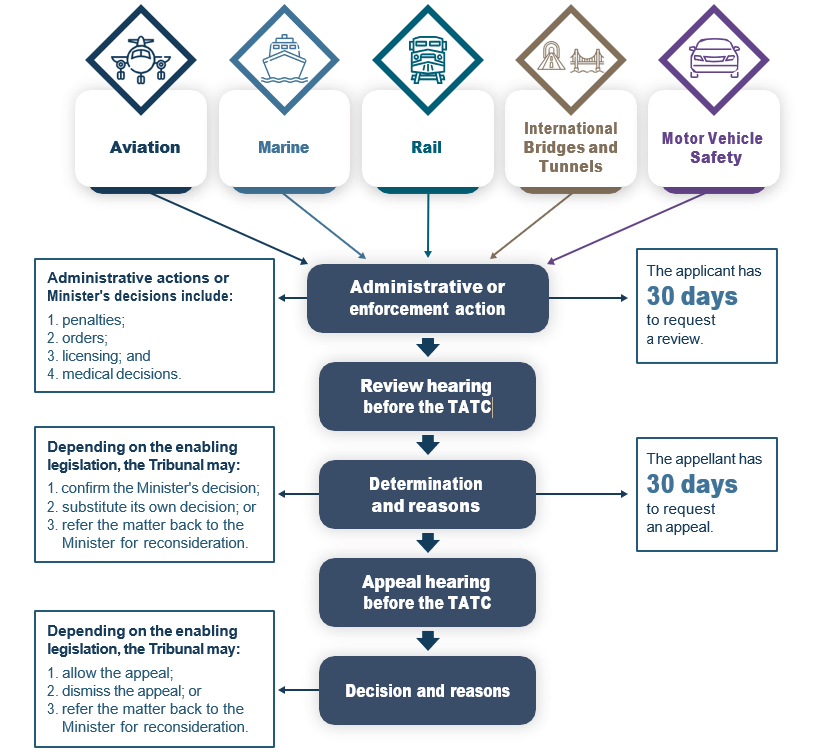
Description
Flowchart describing the Tribunal’s review and appeal process. Six levels are shown:
- The five modes of transportation: aviation, marine, rail, international bridges and tunnels, and motor vehicle safety.
- The Minister’s decision, or administrative or enforcement action, which includes penalties, orders, licensing, and medical decisions. The applicant has 30 days to request a review.
- Review hearing before the TATC.
- Determination and reasons. Depending on the enabling legislation, the Tribunal may confirm the Minister’s decision, substitute its own decision, or refer the matter back to the Minister for reconsideration. The appellant has 30 days to request an appeal.
- Appeal hearing before the TATC.
- Decision and reasons. Depending on the enabling legislation, the Tribunal may allow the appeal, dismiss the appeal, or refer the matter back to the Minister for reconsideration.
Basic Principles
The basic principles governing the Tribunal are those of independence and transportation expertise. The sound, competent, and comprehensive execution of the Tribunal’s mandate determines its effectiveness in dealing with the national transportation community.
Organizational Structure
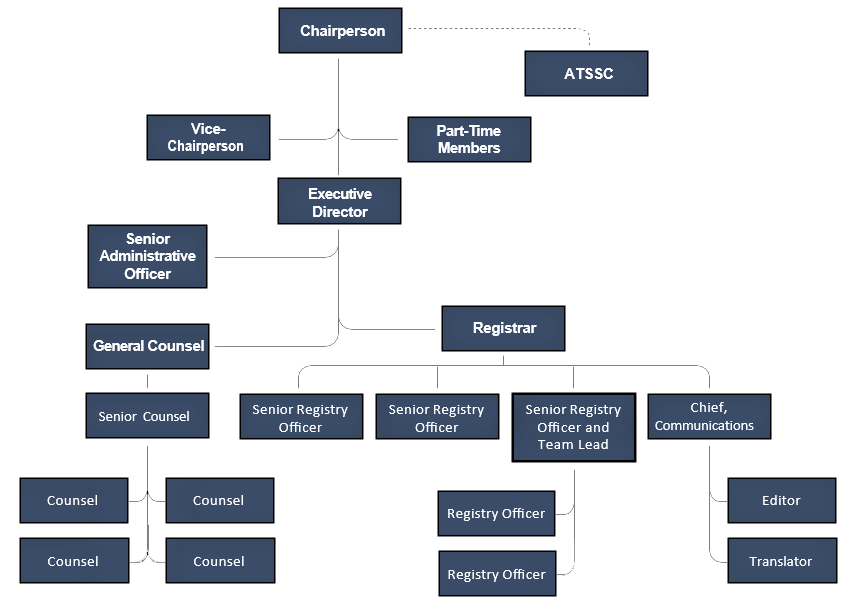
The Tribunal's Chairperson is a full-time member and is its accountable executive, with responsibility for directing and supervising the Tribunal's work under the TATC Act. This includes the apportionment of work among members, the assignment of members to hear matters brought before the Tribunal and, generally, the conduct of the work of the Tribunal and the management of its internal affairs.
The TATC Act also allows for the appointment of a full-time Vice-Chairperson. This position is currently vacant.
The Tribunal receives operational support from the Administrative Tribunals Support Service of Canada (ATSSC), which provides secretariat services and other support under the Administrative Tribunals Support Service of Canada Act.
Part-time members of the Tribunal are drawn from across Canada and are appointed based on their transportation sector knowledge and expertise. In 2023-2024, Tribunal membership included 31 part-time members and one full-time member (the Chairperson).
Organization Chart
In 2023-2004, the TATC received registry, legal, communications and administration services from the ATSSC through an integrated secretariat dedicated to five tribunals. Within the integrated secretariat, 17 public servants provided direct support to the TATC mandate. The integrated approach ensures continuity in services and allows for better resource management.
2023-2024 in Review
Case Management Conferences, Hearings and Decisions
The Tribunal’s effectiveness can be measured by its ability to provide the Canadian transportation community with the opportunity to have ministerial and Canadian Transportation Agency decisions reviewed fairly, equitably and within a reasonable period of time.
“Quality decisions delivered to affected parties in a timely manner” is the hallmark of the TATC. Although the Tribunal will not sacrifice quality for timeliness, a credible and relevant administrative judicial process must endeavour to deliver its decisions to affected parties in an expeditious manner and as informally as possible.
Case Management Conferences
Before a hearing takes place, the Tribunal conducts a case management conference (CMC) with the affected parties. The purpose of the CMC is to confirm any specific issues to be submitted to the Tribunal at the hearing, as well as to discuss any procedural matter or any other matter that may help in the conduct of the hearing and disposition of the proceeding.
Under normal circumstances, the Tribunal acknowledges requests for reviews or appeals within two days of receiving the formal application and schedules a CMC with the parties within the following two to three months. The Tribunal’s goal is to carry out hearings within 12 months of receiving an applicant’s request, and to serve affected parties with review determinations and appeal decisions within 90 and 120 days, respectively, of hearing completion.
During 2023-2024, the Tribunal continued holding CMCs by videoconference in all review and appeal matters, except for rail enforcement cases and only with the consent of the parties. The Tribunal held a total of 105 CMCs in 2023-2024.
The conduct of CMCs is generally very beneficial to the parties and to the Tribunal. CMCs have proven to increase communication between the parties and to assist in resolving matters, where possible, earlier in the process and before a hearing is scheduled. CMCs have also proven to be beneficial for self represented individuals in particular those who have never participated in a hearing process.
In all files, the Tribunal encourages communication and the exchange of documents between the parties to assist in identifying the issues that can be resolved between them before adjudication by the Tribunal. This approach reduces the length of hearings and avoids last-minute adjournments necessitated by late disclosure of information.
“Quality decisions delivered to affected parties in a timely manner” is the hallmark of the TATC. Although the Tribunal will not sacrifice quality for timeliness, a credible and relevant administrative judicial process must endeavour to deliver its decisions to affected parties in an expeditious manner and as informally as possible.
Before a hearing takes place, the Tribunal conducts a case management conference (CMC) with the affected parties. The purpose of the CMC is to confirm any specific issues to be submitted to the Tribunal at the hearing, as well as to discuss any procedural matter or any other matter that may help in the conduct of the hearing and disposition of the proceeding.
Under normal circumstances, the Tribunal acknowledges requests for adjudication within three days of receiving the formal application for a review or appeal hearing and schedules a CMC with the parties as soon as possible. The Tribunal’s goal is to carry out hearings within 12 months of receiving an applicant’s request, and to serve affected parties with review determinations and appeal decisions within 90 and 120 days, respectively, of hearing completion.
During this reporting period, the Tribunal began holding CMCs by videoconference in all review and appeal matters, regardless of the sector of transport or of the case type. The Tribunal held a total of 117 CMCs in 2022-2023.
The conduct of CMCs was generally very beneficial to the parties and to the Tribunal. CMCs have proven to increase communication between the parties and to assist in resolving matters, where possible, earlier in the process and before a hearing is planned.
In all files, the Tribunal encourages communication and the exchange of documents between the parties to assist in identifying the issues that can be resolved between them before adjudication by the Tribunal. This approach reduces the length of hearings and avoids last-minute adjournments necessitated by late disclosure of information.
Hearings
In 2023-2024, the registry scheduled 81 hearings. Of these, 35 were held, 29 were postponed at the request of the parties and 17 were cancelled further to a settlement or withdrawal. As a result, the number of hearings held was lower than the previous two years.
Most of the hearings held during the reporting period were conducted by videoconference and some were dealt with by written submissions or in-person. Virtual hearings, which were introduced in 2020, enabled the Tribunal to hear more cases in a year; it increased efficiencies in the hearing process and access to justice in general while providing more flexibility with member assignment since travel is no longer required. Hearings can still be held in person at the request of one of the parties if the Tribunal is of the opinion that it is the best format for a particular case.
The average lapsed time in 2023-2024 between the conclusion of a review hearing and the issuance of a determination was 118 days (an increase of 4.5 per cent from last year).
In the 2023-2024 reporting period, 114 cases (requests for review and requests for appeal) were closed either by a decision of the Tribunal or by one of the parties. It should be noted that of these cases, many requests filed with the Tribunal were resolved shortly before the hearing was scheduled to take place, which means that all the logistical, administrative and support tasks that lead to a formal hearing were completed by the registry.
The cases concluded without a hearing were resolved in several ways: the applicant paid the fine before the hearing commenced, the applicant’s licence was reinstated by Transport Canada before the hearing, the request for a hearing was withdrawn by the applicant following disclosure, the notice was withdrawn by the Minister, or an agreement was reached between the parties through discussion and negotiation.
Decisions
In 2023-2024, the Tribunal rendered 19 determinations on requests for review, 10 decisions on applications for appeal, 11 determinations on ex parte applications and 69 rulings on motions.
The TATC Decisions collection contains all public decisions rendered by the TATC since 1986, with the notable exception of medical decisions, which are unavailable to the public for privacy reasons. However, the TATC is making summaries of medical decisions available to the public in an effort to increase access to justice.
Training and Development
TATC's commitment to excellence in the delivery of its mandate includes ensuring Tribunal members receive advanced training and development opportunities. When new members are appointed, they receive an intense four-day in-house training in all aspects of administrative law, adjudication, transportation law, and decision writing. In addition, each new member receives specific training in their attributed sector. Serving members receive regular professional development, including webinars and case law updates. Legal counsel assists with pre-hearing, hearing, and post-hearing activities. Members are encouraged to undergo annual professional development. This combined approach helps members to maximize their effectiveness in the adjudicative process, to keep abreast of developments in administrative law and the federal transportation sectors, and to render decisions according to the values and expected outcomes mandated to the Tribunal. The Tribunal’s policies and practice directions are routinely reviewed and updated as required on the TATC website, and all members are kept informed about policy updates, including those pertaining to internal administration.
Training resources for members are available in various formats, including online and electronic formats. Communication with members is continuous and regular updates are provided by the Chairperson regarding the Tribunal’s activities. The Chairperson also provides individual “coaching” when needed and provides guidance when requested. The Tribunal is a corporate member of the Council of Canadian Administrative Tribunals (CCAT) and funded some of the training offered by CCAT for members and staff interested in advancing their knowledge and skills in administrative law and hearing proceedings.
Public Outreach
Public outreach and sector engagement activities are important to the relevance and credibility of the Tribunal, as these events increase the public’s awareness of the Tribunal’s mandate and generate interest in the important role the Tribunal plays in carrying out independent review and appeal hearings for the Minister of Transport and members of Canada’s transportation sectors. Sector engagement is also important for the recruitment of new part-time members.
In 2023-2024, outreach activities took place in the rail, aviation, and marine sectors. In the coming years, the intention is to significantly increase the Tribunal’s presence and visibility to make its mandate known to the public and to the community of experts potentially interested in a position as a Tribunal member.
The Chairperson’s objective is to increase accessibility and access to justice for parties and Tribunal stakeholders by ensuring processes are easy and clear. To achieve this objective, the Tribunal will continue to focus on refining some of its practice directions, policies and guides to parties to make sure they are written in plain language that is comprehensive to all Canadians and that these information resources are as efficient, easy and helpful as possible.
Membership
The Tribunal requires a roster of 40 to 50 part-time members who collectively have the expertise required to adjudicate matters in its five current areas of jurisdiction (aviation, marine, rail, international bridges and tunnels and motor vehicle safety), at the review and appeal levels, and in both official languages.
All current TATC members can adjudicate matters in English, but only 12 members can adjudicate matters in French and in a limited number of sectors of the Tribunal’s jurisdiction. On March 31, 2024, the Tribunal had a backlog of 31 cases from the marine and aviation sector that could not proceed to a hearing due to the temporary shortfall of French-speaking members with the required sector expertise.
Although there have been no new appointments in 2023-2024, discussions with ministerial representative have taken place to both accelerate additional reappointments and open a recruiting process that would account for diversity, inclusiveness, and comply with the Official Language Act, all in collaboration with the Privy Council Office.
Full-Time Chairperson
Gary Drouin
Chelsea, Quebec
Gary Drouin received a Governor in Council appointment on November 22, 2012, as part-time member in the rail and aviation sectors. On October 7, 2022, he was appointed to serve as Vice-chairperson for a full-time term ending on December 17, 2024. Mr. Drouin became Chairperson on November 7, 2022, until a permanent Chairperson is nominated by the Governor in Council.
Part-Time Tribunal Members
The following is a complete list of part-time members who served on the Tribunal in fiscal year 2023-2024:
George Ashley
Ottawa, Ontario
Reappointed to a part-time term of four years on February 18, 2022.
Sandra Attersley
Dartmouth, Nova Scotia
Reappointed to a part-time term of four years on November 29, 2021.
Blaine Beaven
Saskatoon, Saskatchewan
Reappointed to a part-time term of four years on December 2, 2022.
Fazal Bhimji
Delta, British Columbia
Reappointed to a part-time term of three years on December 2, 2022.
Mark S. Conrad
Winnipeg, Manitoba
Reappointed to a part-time term of four years on February 18, 2022.
William R. Cottick
Victoria, British Columbia
Reappointed to a part-time term of three years on December 2, 2022.
Dr. Robert Cronin
Courtenay, British Columbia
Reappointed to a part-time term of four years on April 29, 2022.
Dr. Thomas V. Davis
Victoria, British Columbia
Reappointed to a part-time term of four years on February 18, 2022.
Caroline Desbiens
Sainte-Foy, Quebec
Reappointed to a part-time term of four years on November 29, 2021.
Sébastien Desbiens
Quebec, Quebec
Appointed to a part-time term of five years on April 29, 2022.
Yves Duguay
Montreal, Quebec
Reappointed to a part-time term of four years on December 2, 2022.
Dr. Antoine Gagnon
Ottawa, Ontario
Appointed to a part-time term of five years on April 29, 2022.
Dr. Linda Garand
Montreal, Quebec
Appointed to a part-time term of five years on March 25, 2022.
Martine Guay
Longueuil, Quebec
Term expired on April 15, 2023. Appointed to a part-time term of four years on April 15, 2019.
Raymon J. Kaduck
Ottawa, Ontario
Reappointed to a part-time term of three years on February 18, 2022.
Dr. David Kim
Nanaimo, British Columbia
Appointed to a part-time term of five years on February 18, 2022.
Sarah M. Kirby
Halifax, Nova Scotia
Reappointed to a part-time term of four years on February 18, 2022.
Dr. Ginette Lalonde-Kontio
Ottawa, Ontario
Appointed to a part-time term of five years on February 18, 2022.
Dr. H. Colin MacKay
Nanoose Bay, British Columbia
Term expired on August 4, 2023. Appointed to a part-time term of two years on August 4, 2021.
Joelle Malette
Timmins, Ontario
Appointed to a part-time term of three years on May 18, 2022.
Tracy Medve
Kelowna, British Columbia
Term expired on May 21, 2023. Reappointed to a part-time term of two years on May 21, 2021.
Tim Meisner
Ottawa, Ontario
Appointed to a part-time term of five years on June 23, 2022.
Capt. Steven D. Neatt
Charlesbourg, Quebec
Term expired on May 21, 2023. Appointed to a part-time term of four years on May 21, 2019.
Arnold Marvin Olson
Langley, British Columbia
Reappointed to a part-time term of three years on April 29, 2022.
Dr. Mitchell Pantel
Kirkland, Quebec
Appointed to a part-time term of five years on April 29, 2022.
André Paquette
Gatineau, Quebec
Appointed to a part-time term of four years on June 23, 2022.
Capt. James R. Parsons
St. John’s, Newfoundland and Labrador
Reappointed to a part-time term of four years on December 18, 2020.
Jacqueline Penney
St. John’s, Newfoundland and Labrador
Reappointed to a part-time term of four years on November 29, 2021.
Franco Pietracupa
Dollard-des-Ormeaux, Quebec
Term expired on May 21, 2023. Reappointed to a part-time term of two years on May 21, 2021.
Capt. Marc-André Poisson
Ottawa, Ontario
Term expired on August 19, 2023. Appointed to a part-time term of four years on August 19, 2019.
Michael J. Regimbal
Beaconsfield, Quebec
Reappointed to a part-time term of four years on February 18, 2022.
Dr. Dybesh Regmi
Oakville, Ontario
Appointed to a part-time term of five years on June 20, 2022.
Dr. Peter Seviour
St. John’s, Newfoundland and Labrador
Reappointed to a part-time term of four years on May 18, 2022.
Yves Villemaire
Stittsville, Ontario
Term expired on July 1, 2023. Reappointed to a part-time term of two years on July 1, 2021.
Deborah Warren
Surrey, British Columbia
Reappointed to a part-time term of four years on December 2, 2022.
Keith Whalen
Riverview, New Brunswick
Reappointed to a part-time term of four years on December 2, 2022.
Andrew Wilson
Ottawa, Ontario
Reappointed to a part-time term of four years on December 2, 2022.
Gavin Wyllie
Mount Royal, Quebec
Term expired on July 2, 2023. Appointed to a part-time term of four years on July 2, 2019.
Financial Resources
Financial resources come from an integrated budget managed by the ATSSC. For more information on this subject, we invite readers to consult the Reports section on the ATSSC website.
Statistical Data
The following pages contain data tables based on the Tribunal’s new cases received in 2023-2024 and files carried over from previous fiscal years.
The tables are presented according to various interests and categories:
- Total new cases by case type and sector
- Total new cases by region and sector
- Hearings, motions, and CMCs by sector
- Overview of the last five years
- Historical caseload
This Annual Report covers the 12 months between April 1, 2023, and March 31, 2024. In this reporting period, the Tribunal registered 142 new requests for review (85 aviation, 35 marine, 25 rail) and 3 requests for appeal (3 marine). Of the new 142 requests for review, the Tribunal received 15 new requests on CTA enforcement matters.
Additionally, the Tribunal received 11 ex parte applications pursuant to the Canada Shipping Act, 2001 and 52 requests for the issuance of certificates for non-payment of monetary penalties pursuant to the Aeronautics Act, the Canada Shipping Act, 2001, the Railway Safety Act, the Canada Transportation Act, and the Wrecked, Abandoned or Hazardous Vessels Act.
| Case type/Sector | Enforcement | Licensing | Medical | TOTALS |
|---|---|---|---|---|
| Aviation | 33 | 13 | 39 | 85 |
| Marine | 14 | - | 21 | 35 |
| Rail | 25 | - | - | 25 |
| TOTALS | 72 | 13 | 60 | 145 |
Case distribution by type
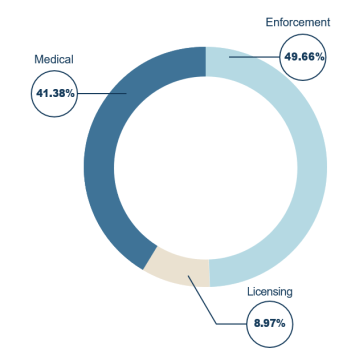
Description
The title of this pie chart is “Case Distribution by type”.
The chart has three segments:
- Medical : 41.38%
- Enforcement: 49.66%
- Licensing: 8.97%
Case distribution by sector
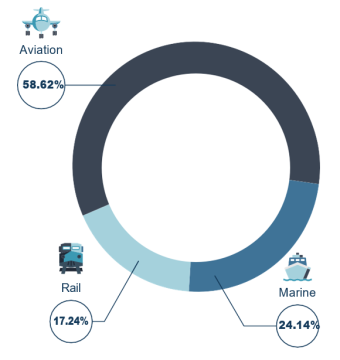
Description
The title of this pie chart is “Case Distribution by sector”.
The chart has three segments:
- Aviation: 58.62%
- Marine: 24.14%
- Rail: 17.24%
| Region/Sector | BC | YK | NT | AB | SK | MA | ON | QC | NB | NS | NL | TOTALS |
|---|---|---|---|---|---|---|---|---|---|---|---|---|
| Aviation | 12 | 1 | 2 | 16 | 1 | 4 | 27 | 21 | - | - | 1 | 85 |
| Marine | 13 | - | - | - | - | - | 1 | 6 | 1 | 8 | 6 | 35 |
| Rail | 1 | - | - | 2 | - | - | 8 | 14 | - | - | - | 25 |
| TOTALS | 26 | 1 | 2 | 18 | 1 | 4 | 36 | 41 | 1 | 9 | 6 | 145 |
Geographical distribution – Cases filed in 2023-2024
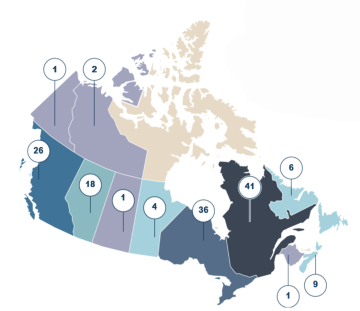
Description
The title of this map chart is “Geographical distribution – Cases filed in 2022-23”.
The chart shows the map of Canada with the number of cases filed in each province or territory:
- British Columbia: 26
- Yukon: 1
- Northwest Territories: 2
- Alberta: 18
- Saskatchewan: 1
- Manitoba: 4
- Ontario: 36
- Quebec: 41
- New Brunswick: 6
- Nova Scotia: 1
- Newfoundland and Labrador: 9
There were no cases in Prince Edward Island.
In each region, the majority of cases are from the aviation sector, followed by the marine sector, with a few exceptions: the majority of cases in the Atlantic region are from the marine sector, followed by the aviation sector. Rail cases represent a smaller proportion of the Tribunal’s caseload although they require more days per hearing due to the cumbersome nature of the evidence and complexity of cases.
| Category/Sector | Hearings | Motion hearing | Motion in writing | CMCs |
|---|---|---|---|---|
| Aviation | 26 | 1 | 51 | 78 |
| Marine | 5 | - | 12 | 14 |
| Rail | 4 | - | 6 | 13 |
| TOTALS | 35 | 1 | 69 | 105 |
Hearings by sector
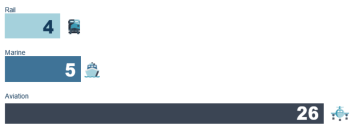
Description
The title of this horizontal bar chart is “Hearings by sector”.
The chart has three horizontal data bars:
- Rail: 4
- Marine: 5
- Aviation: 26
| 2023-2024 | 2022-2023 | 2021-2022 | 2020-2021 | 2019-2020 | |
|---|---|---|---|---|---|
| New requests | 145 | 175 | 171 | 162 | 181 |
| CMCs | 105 | 117 | 117 | 38 | - |
| Review Hearings | 27 | 34 | 56 | 12 | 21 |
| Appeal Hearings | 8 | 8 | 3 | 7 | 10 |
| Certificate on non-payment | 52 | 73 | 70 | 44 | 28 |
| Decisions | 29 | 40 | 44 | 17 | 52 |
| Rulings on motions | 69 | 66 | - | - | - |
Historical Caseload
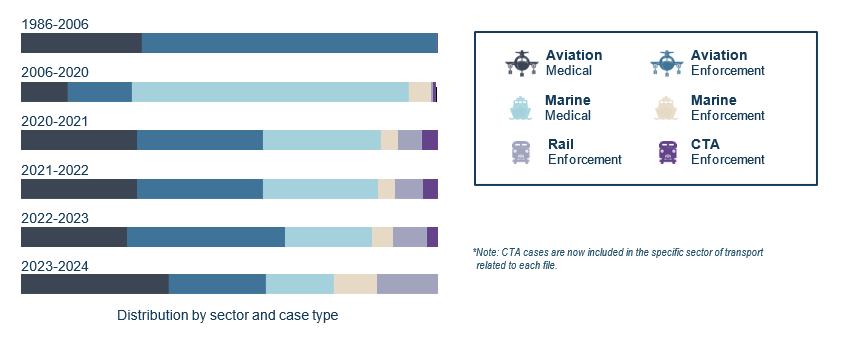
Description
The title of this horizontal stacked bar chart is “Historical case distribution by sector, case type and period”.
The chart has six data bars for the following years:
- 1986-2006
- 2006-2019
- 2019-2020
- 2020-2021
- 2021-2022
- 2022-2023
Each year shows the case distribution by category:
- Aviation Medical
- Aviation Enforcement
- Marine Medical
- Marine Enforcement
- Rail Enforcement
- CTA Enforcement
Note: CTA cases are now included in the specific sector of transport related to each file.
This table shows the evolution of the Tribunal from a unimodal to a multimodal Tribunal. It was only at the beginning of the previous decade that the Tribunal began to see a significant number of cases from sectors other than aviation. Aviation cases represented 58% of cases filed with the Tribunal during the 2023-2024 fiscal year and 27% for marine cases. Over the last decade, there has been a constant increase in rail cases